
Hair fall is one of the most common concerns among people living in Bangalore. Many notice increased shedding, dryness, rough texture or reduced hair volume after moving to the city and immediately blame the local water.
The concern is understandable. Depending on the neighbourhood and building, residents may receive Cauvery water, borewell water, tanker water or a combination of different sources. Bengaluru Water Supply and Sewerage Board supplies treated Cauvery water across the city, while borewells also remain part of the broader supply system. This means that water composition may differ between localities and even between neighbouring apartment buildings.
However, the relationship between hard water and hair loss is more complicated than it is often presented on social media.
Hard water may leave deposits on the hair shaft, interfere with cleansing and make the hair feel rough, dry or difficult to manage. In some people, this may contribute to tangling and breakage. But there is limited evidence that hard water alone directly damages healthy hair follicles or causes permanent hair loss from the roots.
Hair that breaks because it has become dry is different from hair that falls because of hormonal, nutritional, genetic or medical conditions. Understanding this difference is essential before purchasing expensive filters, supplements or hair-growth treatments.
What Is Hard Water?
Water hardness refers mainly to the amount of dissolved calcium and magnesium present in water. As groundwater passes through soil and rock, it can absorb these naturally occurring minerals.
Hard water is not necessarily unsafe for bathing or drinking simply because it contains calcium and magnesium. The term describes its mineral content rather than contamination.
According to commonly used classifications based on calcium carbonate concentration:
- Water containing 0–60 mg/L is considered soft.
- Water containing 61–120 mg/L is moderately hard.
- Water containing 121–180 mg/L is hard.
- Water containing more than 180 mg/L is very hard.
Hard water can react with soap and reduce its ability to lather. It may also leave deposits on bathroom fittings, showerheads, glass and other surfaces.
Similar residue may accumulate on the hair and scalp, particularly when cleansing and rinsing are inadequate.
Why Is Hard Water Commonly Blamed for Hair Fall in Bangalore?
People often connect their hair concerns to hard water when they notice changes soon after moving to Bangalore. Common complaints include:
- Increased hair seen in the shower
- Rough or straw-like texture
- Hair that tangles easily
- Reduced shine
- Dry or itchy scalp
- Flaking
- Increased breakage during combing
- Shampoo that does not lather properly
- Hair that feels coated after washing
- Faster fading of coloured hair
These observations may be real, but they do not confirm that hard water is the only cause.
Relocation can also bring changes in climate, diet, sleep, stress, work schedule, pollution exposure, hair products and washing habits. A person may simultaneously experience nutritional deficiency, thyroid imbalance, hormonal hair loss or stress-related shedding.
Therefore, timing alone cannot establish the diagnosis.
Hair Fall and Hair Breakage Are Not the Same
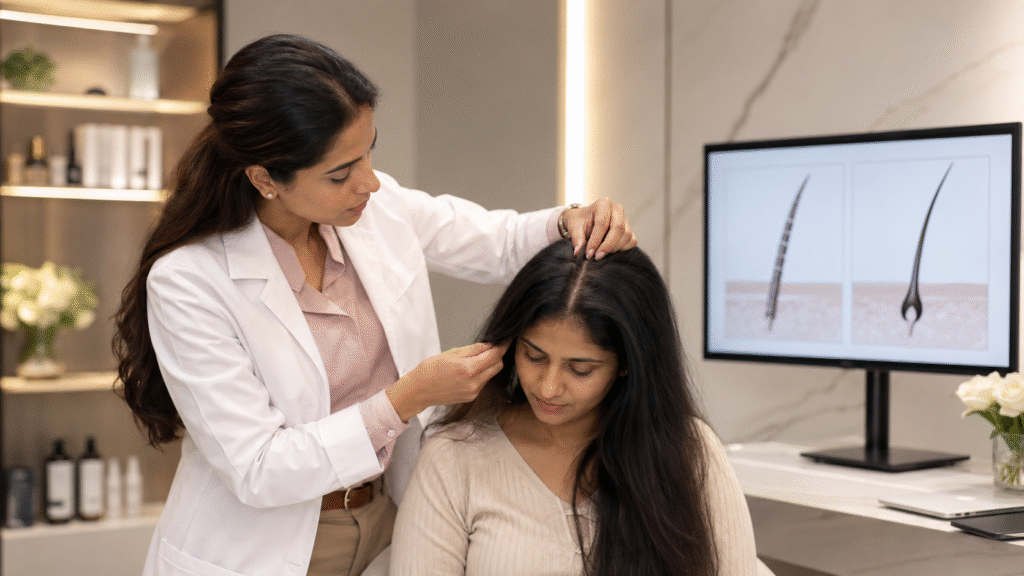
The phrase “hair fall” is often used for two different problems: shedding from the root and breakage along the hair shaft.
Hair Shedding from the Root
Hair shedding occurs when the complete hair separates from the follicle as part of the hair-growth cycle.
The shed strand is usually close to its original length and may have a small pale or club-shaped structure at one end. Excessive root-level shedding may be associated with telogen effluvium, hormonal changes, nutritional deficiencies, illness, stress or other medical conditions.
The American Academy of Dermatology states that losing approximately 50–100 hairs per day can be normal. Shedding significantly beyond this level may indicate excessive hair shedding, although accurately counting every strand is rarely practical.
Hair Breakage
Breakage occurs when the hair shaft snaps somewhere between the scalp and the ends.
Broken strands may:
- Be shorter than the rest of the hair
- Have split or frayed ends
- Lack the small club-shaped root
- Produce uneven lengths around the scalp
- Cause increased frizz
- Make the ponytail appear thinner despite normal root growth
Heat styling, bleaching, chemical straightening, friction, tight hairstyles, rough handling and inadequate conditioning can all weaken the hair shaft. Chemical straightening procedures have also been associated with shaft damage and scalp inflammation.
Hard water is more plausibly connected with changes in the hair shaft and manageability than with the destruction of healthy follicles.
What Does Research Say About Hard Water and Hair?
Research on hard water and human hair remains limited, and the available studies have produced mixed results.
One laboratory study compared hair treated with hard water against hair treated with distilled water. It did not find a statistically significant difference in tensile strength or elasticity between the groups.
Another study reported a reduction in hair-shaft tensile strength after exposure to hard water compared with deionised water.
Microscopic research has also found increased mineral deposits on hair exposed to hard water, but these deposits did not always correspond to obvious structural changes on the surface of the shaft.
These studies were generally small and laboratory-based. They do not prove that bathing in hard water causes follicular hair loss, baldness or permanent thinning in everyday life.
The most reasonable conclusion is that hard water may influence the physical condition and appearance of the hair in some people. It may contribute to residue, roughness, friction and breakage, especially when combined with chemical treatments, heat styling or inadequate conditioning. However, persistent shedding from the roots should not automatically be attributed to water.
How Hard Water May Affect the Hair Shaft
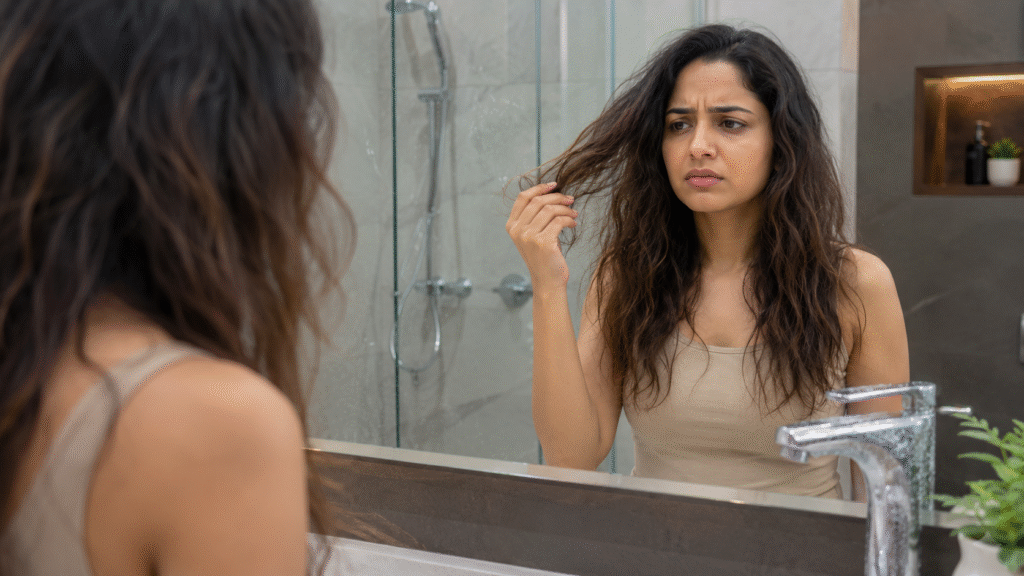
1. Mineral Buildup
Calcium and magnesium may interact with shampoo, soap and styling-product residue. Over time, this can leave the hair feeling coated, heavy or difficult to rinse.
A coated hair shaft may reflect light poorly, making the hair appear dull even when it is otherwise healthy.
2. Reduced Shampoo Lather
Hard water reacts with cleansing products and can reduce lather formation. People may respond by using more shampoo or washing repeatedly.
Excess shampooing, particularly with strong cleansers, may remove protective oils and worsen dryness. Hard water itself may therefore not be the only issue—the washing habits adopted in response to it can also affect the hair.
3. Increased Roughness and Friction
When the outer cuticle becomes rough, individual strands rub against each other more easily.
This may cause:
- Tangling
- Frizz
- Difficult detangling
- Split ends
- Snapping during brushing
- Reduced softness
Research on shampoo formulation suggests that highly alkaline products can increase electrical charge and friction on the hair surface, potentially increasing cuticle damage and breakage. Lower-pH formulations may produce less frizz and friction.
4. Dry or Brittle Hair
Mineral residue and repeated cleansing can make hair feel dry. Hair that has already been coloured, bleached, straightened or heat-styled may be especially vulnerable.
The concern is generally greater for the hair shaft than for the living follicle beneath the skin.
5. Changes in Coloured or Chemically Treated Hair
Chemically treated hair already has a more vulnerable cuticle. Additional residue, repeated washing and heat exposure may make it feel rough or cause colour to appear dull.
People with bleached or straightened hair may notice the effect of unsuitable water and haircare more quickly than those with untreated hair.
Can Hard Water Cause Dandruff?
Hard water is not considered the sole cause of dandruff.
Dandruff is generally regarded as a mild form of seborrhoeic dermatitis and can cause recurrent scalp flaking. It is influenced by scalp oil, skin-cell turnover, microorganisms and individual susceptibility.
However, hard water may indirectly make an already sensitive scalp feel uncomfortable. Residual cleanser, repeated washing, hot showers or harsh shampoo may contribute to dryness, irritation or flaking.
It is important to distinguish between:
- Dry scalp
- Dandruff
- Seborrhoeic dermatitis
- Psoriasis
- Allergic contact dermatitis
- Fungal infection
- Product buildup
These conditions may look similar but require different treatment.
Applying oil repeatedly without confirming the cause may worsen some oily or dandruff-prone scalps. Persistent itching, redness, thick scales or painful areas should be evaluated by a dermatologist.
Does Hard Water Damage the Hair Follicle?
The hair shaft visible above the scalp is made primarily of keratinised material. The follicle responsible for producing hair sits within the skin.
Mineral buildup on the external hair shaft does not automatically mean that the follicle has been permanently damaged.
There is currently insufficient evidence to conclude that ordinary exposure to hard water directly causes conditions such as:
- Male-pattern hair loss
- Female-pattern hair loss
- Alopecia areata
- Scarring alopecia
- Postpartum shedding
- Thyroid-related hair loss
- Nutritional hair loss
These conditions involve genetic, hormonal, autoimmune, inflammatory or systemic mechanisms.
Hard water may worsen the appearance of thinning by increasing dryness and breakage. It may also make the scalp feel uncomfortable, but it should not become a convenient explanation that delays diagnosis of the actual problem.
Common Causes of Hair Fall Often Mistaken for Hard-Water Damage
1. Telogen Effluvium
Telogen effluvium causes increased shedding when a larger-than-usual number of follicles enter the resting phase of the hair cycle.
Possible triggers include:
- Severe stress
- High fever
- Viral illness
- Surgery
- Rapid weight loss
- Crash dieting
- Childbirth
- Nutritional deficiency
- Certain medications
- Major emotional events
The shedding often begins weeks or months after the triggering event rather than immediately.
2. Female-Pattern or Male-Pattern Hair Loss
Genetic hair loss generally develops gradually.
Women may notice:
- Widening of the centre part
- Reduced density over the crown
- A thinner ponytail
- Increased scalp visibility
Men may notice:
- Receding temples
- Thinning at the crown
- Progressive reduction in frontal density
Early diagnosis is important because preserving active follicles is often easier than treating advanced miniaturisation.
3. Iron and Nutritional Deficiencies
Iron deficiency, inadequate protein intake and certain vitamin or mineral deficiencies may contribute to hair shedding in susceptible individuals.
However, supplements should not be taken randomly. Excessive intake of some nutrients can also worsen hair loss or create other health problems.
4. Thyroid and Hormonal Conditions
Thyroid disorders, polycystic ovary syndrome, postpartum hormonal changes and perimenopause may affect the hair-growth cycle.
Women with irregular periods, acne, increased facial hair or sudden weight changes may require medical assessment in addition to scalp treatment.
5. Scalp Disorders
Inflammatory or infectious scalp conditions may interfere with healthy hair retention.
Warning signs include:
- Persistent itching
- Burning or pain
- Thick scales
- Redness
- Pus-filled bumps
- Circular bald patches
- Scarring
- Shiny areas without visible follicle openings
These findings should not be treated only with cosmetic shampoo or water filters.
6. Tight Hairstyles
Repeatedly wearing tight ponytails, buns, braids or extensions can place excessive tension on the follicles.
Long-term traction may lead to permanent hair loss if the pulling continues.
7. Heat and Chemical Damage
Frequent straightening, bleaching, rebonding, keratin treatments and high-temperature styling can weaken the shaft.
Applying high heat to wet or damp hair may increase structural damage.
When chemical damage and mineral residue occur together, breakage may become more noticeable.
Signs That Water May Be Affecting Hair Quality
Water-related buildup may be more likely when you notice:
- White scale around taps and showerheads
- Poor shampoo lather
- Hair that feels coated immediately after washing
- Increasing roughness without significant root shedding
- Tangling primarily through the lengths
- Short broken strands
- Split ends
- Dull-looking coloured hair
- Improvement when washing elsewhere
- Better texture after using properly softened water
These signs suggest that water may be contributing to hair-shaft problems. They do not establish the cause of progressive scalp thinning.
How Can You Check Whether Your Water Is Hard?
Do not rely only on how the water feels.
Water hardness can be measured through:
- A laboratory water-quality test
- A hardness test kit
- Information from the building or water supplier
- Testing the specific household source
A TDS meter measures total dissolved solids, not calcium and magnesium hardness alone. A high TDS reading may indicate a large amount of dissolved material, but it does not identify which minerals are present. A dedicated hardness test is more useful when the concern is calcium and magnesium.
Because apartment buildings may switch between different sources, one test may not represent the water supplied throughout the entire year.
Dermatologist-Recommended Hair and Scalp Plan for Hard-Water Areas

Step 1: Identify Whether the Problem Is Breakage or Root-Level Shedding
Examine the strands you are losing.
Short, uneven strands suggest breakage. Full-length strands and progressive reduction in density may indicate shedding or follicular hair loss.
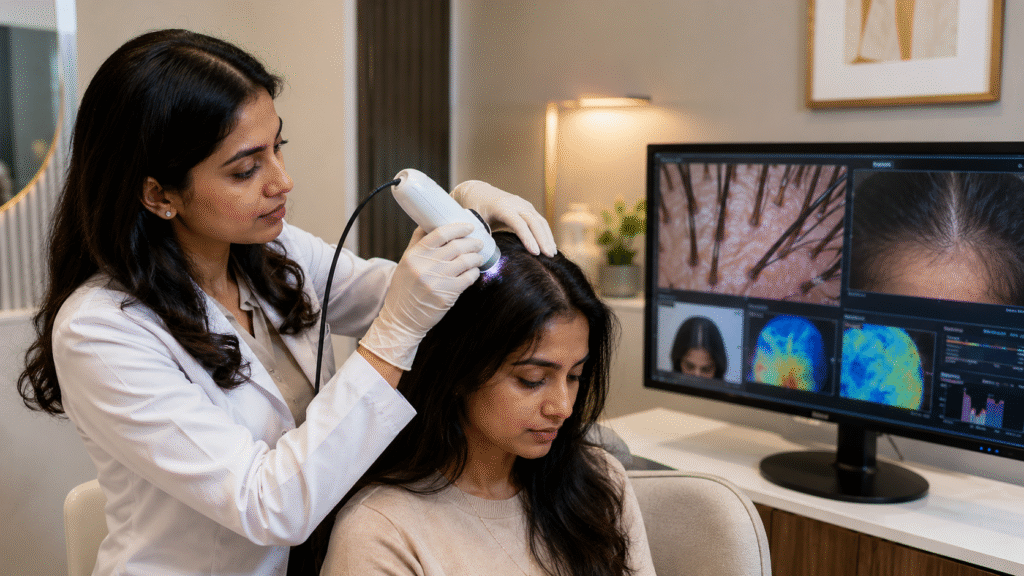
A dermatologist may use scalp examination, dermoscopy or a hair-pull test to distinguish between different causes. Effective hair-loss treatment begins with identifying the correct diagnosis.
Step 2: Use a Gentle Shampoo Suitable for the Scalp
Choose shampoo according to scalp type rather than following generic claims such as “chemical-free.”
A suitable cleanser should remove sweat, oil and product residue without leaving the scalp persistently dry or irritated.
People with oily scalps may require more frequent washing than those with dry scalps. Avoiding shampoo for long periods is not automatically healthier.
Step 3: Consider an Occasional Clarifying or Chelating Product
A clarifying or chelating shampoo may help reduce mineral and styling-product residue.
However, these shampoos may be drying if used too frequently. Usage should depend on:
- Water hardness
- Hair texture
- Colour treatment
- Scalp condition
- Washing frequency
- Product strength
For many people, occasional use is more appropriate than daily use. A dermatologist can recommend a suitable frequency for fragile, coloured or chemically treated hair.
Step 4: Condition the Hair Lengths
Conditioner reduces friction between strands and improves manageability.
Apply it mainly through the mid-lengths and ends unless the product is specifically designed for scalp use. Allow it to remain for the recommended duration before rinsing.
A leave-in conditioner or detangling product may be helpful for curly, long, bleached or breakage-prone hair.
Step 5: Avoid Very Hot Water
Very hot showers may increase dryness and scalp discomfort.
Use lukewarm water and avoid prolonged soaking. Pat or squeeze the hair gently rather than rubbing aggressively with a towel.
Step 6: Detangle Carefully
Wet hair can be more vulnerable to stretching and mechanical damage.
Use:
- A wide-toothed comb
- A detangling brush designed for wet hair
- Conditioner or leave-in detangler
- Gentle movements beginning at the ends
Avoid repeatedly pulling through tight knots.
Step 7: Reduce Heat and Chemical Stress
When hair is already rough or brittle, minimise:
- Daily straightening
- High-temperature blow-drying
- Repeated bleaching
- Frequent rebonding
- Tight hairstyles
- Aggressive brushing
Reducing these factors may produce a greater improvement than changing water alone.
Step 8: Protect the Scalp Barrier
Avoid applying concentrated vinegar, lemon juice, baking soda or other household acids and alkalis directly to the scalp.
Incorrectly prepared home rinses may cause irritation, chemical burns or worsening inflammation.
Step 9: Treat Dandruff Correctly
A medicated shampoo may be required when true dandruff or seborrhoeic dermatitis is present.
Use it according to medical or product instructions and allow sufficient contact time before rinsing. Persistent symptoms require assessment because not every flaky scalp is dandruff.
Step 10: Investigate Persistent Shedding
When root-level shedding continues, a dermatologist may consider investigations based on the medical history and examination.
These may include assessment for:
- Iron deficiency
- Thyroid dysfunction
- Vitamin deficiencies
- Hormonal conditions
- Recent illness
- Medication-related shedding
- Genetic hair loss
Testing should be personalised rather than ordering every available blood test.
Do Shower Filters Solve Hard-Water Hair Problems?
Not every shower filter softens water.
Many common shower filters are designed mainly to reduce substances such as chlorine, odour or sediment. They may improve the shower experience but may not significantly remove dissolved calcium and magnesium.
True water softening generally uses ion exchange, which removes calcium and magnesium ions and replaces them with sodium or potassium ions.
Before purchasing a product, check:
- Whether it specifically reduces hardness
- Its tested capacity
- The technology used
- Replacement requirements
- Flow-rate compatibility
- Independent certification
- Whether it is a filter, conditioner or true softener
Marketing terms such as “anti-hair-fall filter” do not prove that the device prevents medical hair loss.
Can a Final Rinse with Filtered Water Help?
Some people find that rinsing the hair lengths with softened or low-mineral water improves softness and manageability.
This may reduce the residue left during the final rinse, but it is not a treatment for genetic, hormonal or nutritional hair loss.
It may be a practical trial for people who cannot install a whole-house softener. Evaluate improvements in texture, tangling and breakage over several weeks rather than expecting immediate regrowth.
Should You Use Bottled Water for Every Hair Wash?
Using bottled water for every wash is usually inconvenient, expensive and environmentally wasteful.
Before taking this step:
- Confirm that the water is actually hard.
- Determine whether the concern is breakage or root-level shedding.
- Improve shampoo and conditioning practices.
- Reduce heat and chemical damage.
- Seek medical assessment when density is reducing.
A complete change of water supply may not solve hair loss caused by an underlying condition.
Can Oiling Protect Hair from Hard Water?
Pre-wash oiling may reduce friction and help some hair types feel softer.
Coconut oil has been studied for its ability to penetrate the hair shaft and reduce protein loss under certain conditions, but oiling does not remove calcium and magnesium from water and does not treat follicular hair loss.
Apply a small amount mainly to the lengths when suitable. Heavy oiling may be uncomfortable for oily, acne-prone or dandruff-affected scalps.
Do not leave oil on an inflamed scalp for prolonged periods without professional guidance.
When Should You Consult a Dermatologist?
Arrange a professional evaluation when you notice:
- Sudden or heavy shedding
- A widening centre part
- Receding hairline
- Visible scalp at the crown
- Circular bald patches
- Persistent itching or pain
- Thick scales or redness
- Scarring or shiny bald areas
- Hair loss continuing for more than a few months
- Loss of eyebrows or eyelashes
- Acne, irregular periods or increased facial hair
- Hair thinning with fatigue or unexplained weight changes
- No improvement after modifying haircare and water exposure
Haircare changes may improve breakage, but they cannot replace diagnosis and treatment when follicles are progressively thinning.
What Results Can You Realistically Expect?
When hard water is contributing mainly to residue and breakage, improving the washing routine may make the hair feel:
- Softer
- Less tangled
- Easier to comb
- More manageable
- Less coated
- Less prone to snapping
These improvements may appear sooner than changes in overall density.
Follicular hair growth is slow. Treatment for actual hair loss generally requires several months, and the outcome depends on the diagnosis, duration of the condition and condition of the follicles.
Products promising instant regrowth after changing a shower filter should be viewed cautiously.

Conclusion
Bangalore’s hard water may contribute to mineral buildup, roughness, tangling, dryness and hair-shaft breakage in some people. However, current evidence does not establish hard water as a direct cause of permanent follicular hair loss.
A sudden increase in hair fall should not automatically be blamed on the city’s water. Stress, illness, genetic hair loss, thyroid disorders, hormonal changes, nutritional deficiencies, scalp disease and chemical damage may all be responsible.
The most useful approach is to confirm the water quality, distinguish breakage from root-level shedding and follow a gentle scalp and haircare routine. When hair density is reducing, the centre part is widening or shedding remains persistent, a dermatologist-guided assessment can identify the actual cause and prevent unnecessary delays in treatment.