

Aesthetic treatments are changing.
Earlier, people often searched for one treatment to solve one concern. A chemical peel for pigmentation. Microneedling for texture. Fillers for volume loss. Skin tightening for laxity.
Today, the approach is becoming more personalised.
Instead of expecting one procedure to correct every concern, doctors increasingly look at the skin and face in different layers. One treatment may improve texture, another may support firmness, while another may address pigmentation or volume.
This approach is often called treatment stacking or combination treatment planning.
The goal is not to perform as many procedures as possible. It is to combine the right treatments, in the right order, for the right concerns.
What Is Treatment Stacking?
Treatment stacking means planning two or more complementary aesthetic treatments as part of one overall treatment strategy.
The treatments do not always have to be performed on the same day.
In many cases, they may be spaced over several weeks or months depending on:
- Your skin concern
- Skin type
- Recovery time
- Treatment intensity
- Previous procedures
- Treatment goals
For example, someone concerned about acne scars may also have pigmentation and uneven texture.
One procedure may target deeper scars, while another may focus more on pigmentation or surface texture.
Treating the concerns separately can sometimes create a more balanced plan than expecting one treatment to do everything.
Why One Treatment May Not Be Enough
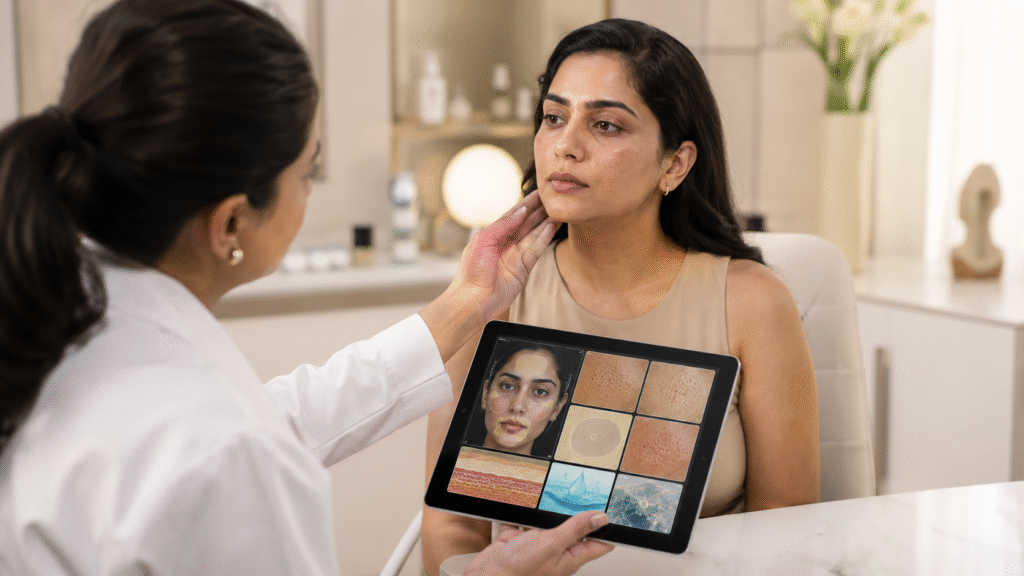
Skin and facial ageing are complex.
A person who says, “My skin looks tired,” may actually have several different concerns at the same time.
These could include:
- Dehydration
- Pigmentation
- Uneven texture
- Enlarged pores
- Reduced skin firmness
- Fine lines
- Facial volume loss
- Acne scars
These concerns involve different layers of the skin and face.
A treatment designed mainly for pigmentation may not restore lost facial volume.
A filler may restore volume but will not necessarily correct acne scars.
A skin-tightening treatment may improve firmness but may not be the best solution for surface pigmentation.
This is why treatment selection should begin with understanding the actual problem.
Treatment Stacking Is Not the Same as Doing Everything at Once
The word “stacking” can sometimes sound like several procedures are simply combined into one appointment.
That is not necessarily the case.
Good treatment planning considers how different procedures interact with each other and how much recovery time the skin needs.
Some treatments may be combined in the same session when appropriate.
Others may be better performed separately.
The sequence may also matter.
For example, active acne may need to be controlled before focusing heavily on acne scars.
Similarly, a damaged skin barrier may need to recover before stronger procedures are considered.
The objective is a logical treatment plan, not treatment overload.
Common Concerns That May Benefit From a Combination Approach
Acne Scars and Uneven Texture
Acne scars are not always identical.
Some are deeper.
Some are shallow.
Others are accompanied by enlarged pores, pigmentation, or uneven skin texture.
Microneedling RF may be considered for suitable patients when the goal is to improve acne scars, pores, texture, and collagen remodelling.
However, if significant pigmentation or active acne is also present, those concerns may require additional treatment planning.
A combination approach allows different parts of the problem to be addressed separately.
Pigmentation and Dull Skin
Pigmentation can appear as tanning, post-acne marks, uneven tone, melasma, or other dark patches.
A treatment plan may include professional peels, appropriate skincare, sun protection, and other pigmentation-focused procedures depending on the type of pigmentation.
If the skin also looks dehydrated or rough, improving hydration and skin quality may form another part of the plan.
Treating pigmentation without controlling sun exposure or maintaining daily skincare may also limit results.
Loose Skin and Reduced Firmness
Skin can gradually lose firmness due to ageing, collagen reduction, sun exposure, weight changes, and other factors.
RF-based procedures may be considered when the goal is to support skin firmness and collagen remodelling.
Microneedling RF may also be used for concerns involving texture and firmness.
However, skin laxity may sometimes occur together with facial volume loss.
In those cases, tightening alone may not fully address the overall appearance.
This is where facial assessment becomes important.
Facial Volume Loss and Skin Quality
Facial volume changes can occur naturally with age or after significant weight loss.
Dermal fillers may be considered to restore selected areas of facial support or volume.
However, fillers primarily address structure and volume.
If the person also has rough texture, poor hydration, pigmentation, or reduced skin firmness, additional treatments may be considered separately.
This helps avoid the mistake of trying to correct every facial concern with filler alone.
How Treatment Stacking Can Be Planned

A well-designed combination plan usually begins with identifying priorities.
For example, the sequence may look something like this:
Step 1: Control Active Problems
Active acne, irritation, or a damaged skin barrier may need attention first.
Step 2: Correct Specific Concerns
This may include pigmentation, acne scars, texture, unwanted hair, or other concerns.
Step 3: Improve Skin Quality
Once major concerns are controlled, the focus may shift toward hydration, smoothness, firmness, and overall skin quality.
Step 4: Maintain the Results
Skincare, sunscreen, periodic treatments, and lifestyle habits may help maintain improvements.
The exact sequence can differ significantly from one person to another.
Can Chemical Peels Be Combined With Other Treatments?
Chemical peels are commonly used for concerns such as pigmentation, acne marks, dullness, tanning, and uneven texture.
Depending on the skin and treatment plan, they may be used between other procedures rather than being performed at the same time.
For example, someone receiving treatment for acne scars may also require pigmentation management.
A peel may therefore form one part of a broader programme.
The strength and timing of the peel should be selected according to the skin type and other treatments being performed.
Microneedling RF as Part of a Combination Plan
Microneedling RF combines controlled microneedling with radiofrequency energy.
It may be considered for concerns such as:
- Acne scars
- Enlarged pores
- Uneven texture
- Skin firmness
- Collagen support
If the patient also has pigmentation, facial volume changes, or other concerns, Microneedling RF may form only one part of the treatment strategy.
The number of sessions and spacing should depend on the individual skin condition.
Where Do Skin Boosters Fit?
Skin boosters focus more on skin quality than dramatic facial reshaping.
They may be considered when concerns include hydration, skin texture, or overall skin appearance.
For someone who also has pigmentation, acne scars, or laxity, a skin booster may be used as part of a wider plan rather than as the only treatment.
This is another example of why different treatments should be selected for different goals.
Can Fillers and Skin Tightening Be Used Together?
Volume loss and loose skin are different concerns.
Some people may have one without the other.
Others may have both.
Dermal fillers may be considered for carefully selected areas where volume or structural support has reduced.
RF-based treatments may be considered when the concern involves skin firmness.
When both concerns are present, a doctor may plan them separately based on facial anatomy and treatment priorities.
The aim should always be natural facial balance rather than excessive correction.
Why Treatment Order Matters
Performing the right treatments in the wrong order can make a treatment plan less efficient.
For example:
- Treating scars while acne is still very active may not address the source of new scars.
- Performing aggressive procedures on irritated skin may increase sensitivity.
- Adding volume before properly assessing facial proportions may lead to unnecessary treatment.
- Repeating exfoliating procedures too frequently can compromise the skin barrier.
A structured treatment sequence allows the skin to recover and makes it easier to evaluate progress between sessions.
How Much Time Should Be Kept Between Treatments?
There is no universal gap that applies to every procedure.
Treatment spacing depends on:
- Procedure type
- Treatment intensity
- Skin sensitivity
- Recovery response
- Treatment area
- Previous sessions
- Overall treatment plan
Some treatments may require only a short recovery period, while others may need several weeks before another procedure is performed.
Following a personalised schedule is safer than creating a treatment calendar based on social media recommendations.
More Treatments Do Not Always Mean Better Results
Treatment stacking should never mean doing unnecessary procedures.
Adding more treatments can increase:
- Cost
- Downtime
- Skin irritation
- Complexity
- Risk of overtreatment
A good plan should be as simple as possible while still addressing the main concerns.
Sometimes one treatment is enough.
Sometimes two complementary treatments make sense.
Sometimes the best decision is to wait before adding another procedure.
The number of treatments should never become the measure of how good a treatment plan is.
Who May Benefit From Treatment Stacking?
Combination treatment planning may be useful for people who have several concerns at the same time.
For example:
- Acne scars with pigmentation
- Enlarged pores with uneven texture
- Facial volume loss with mild laxity
- Dullness with dehydration and uneven tone
- Skin laxity with textural changes
- Mature skin with multiple signs of ageing
However, not everyone needs combination treatments.
A proper consultation helps determine whether one procedure or a staged combination plan is more appropriate.
Why Personalised Planning Matters
Two people may appear to have the same concern but require completely different treatments.
For example, two people may both complain about a poorly defined jawline.
One may have mild skin laxity.
Another may have facial volume changes.
Another may have increased fat below the chin.
Treating all three people with the same procedure would not make sense.
At Aestheticaa by Dr Madhulika in Indiranagar, Bengaluru, treatment planning is based on individual skin concerns, facial structure, skin quality, treatment history, and personal goals.
The focus is on identifying which concern should be treated first and whether a combination approach is genuinely necessary.
What Should You Ask Before Combining Treatments?
Before starting a treatment plan, it can be useful to ask:
- What exactly is each treatment addressing?
- Why are these treatments being combined?
- Will they be performed together or separately?
- How much recovery time is expected?
- Which concern should be treated first?
- How many sessions may be required?
- What skincare should be used between treatments?
- Are all of the recommended procedures actually necessary?
Understanding the purpose of each treatment makes the plan easier to follow and helps set realistic expectations.

Conclusion
Modern aesthetic treatment is moving away from the idea that one procedure can solve every skin concern.
Pigmentation, acne scars, skin texture, volume loss, dehydration, and laxity are different problems that may involve different layers of the skin and face.
Treatment stacking allows these concerns to be approached in a structured way by combining complementary treatments when appropriate.
The important part is not how many treatments are included.
It is whether every treatment has a clear purpose.
A personalised, carefully sequenced plan can help address multiple concerns while avoiding unnecessary procedures and maintaining natural-looking results.