
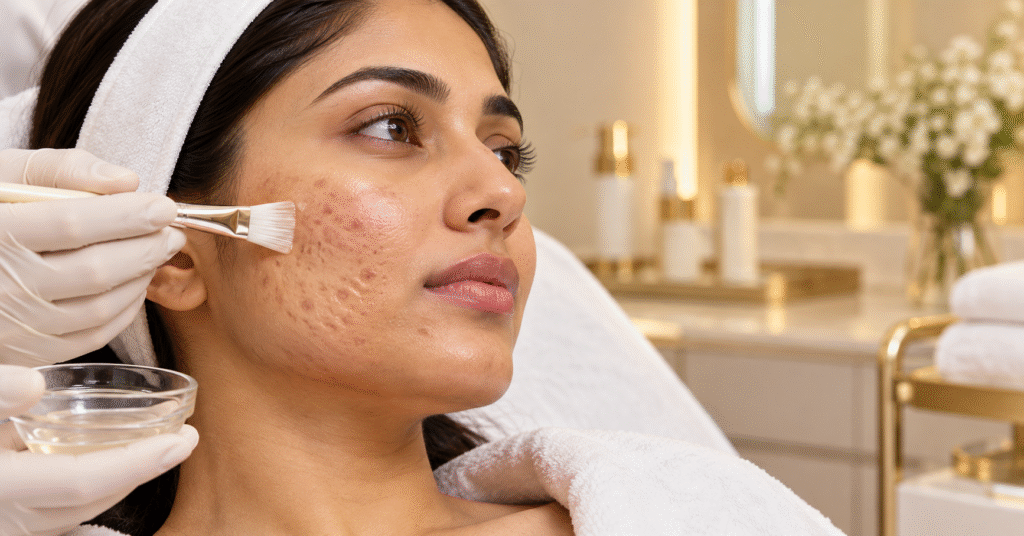
Acne may disappear after a few weeks, but the marks it leaves behind can remain visible for months. Some people notice brown spots where pimples once appeared, while others develop uneven skin texture or small depressions on their cheeks.
Although these changes are often described as acne scars, they are not all the same. More importantly, they do not respond equally to every treatment.
Chemical peels for acne marks can help improve certain types of post-acne pigmentation and superficial skin irregularities. However, effectiveness depends on whether the concern involves skin colour, surface texture or deeper tissue damage.
Understanding these differences is the first step towards choosing appropriate treatment.
Understanding the Difference Between Acne Marks and Acne Scars
Acne marks and acne scars develop through different processes. When acne causes inflammation, the skin begins a natural healing response. Sometimes this produces excess pigment or leaves temporary redness. In other cases, deeper structural skin damage leads to lasting changes in texture.
1. Post-Inflammatory Hyperpigmentation: Dark Acne Marks
Post-inflammatory hyperpigmentation, commonly called PIH, appears as brown, greyish-brown or dark spots after acne heals. It develops when inflammation stimulates excess melanin production and is particularly common in medium to deeper skin tones.
Unlike true scars, PIH does not usually change the skin’s surface. The area remains flat, although its colour differs from surrounding skin. Chemical peels may help improve these marks through controlled exfoliation and skin renewal.
2. Post-Inflammatory Erythema: Red Acne Marks
Some acne lesions leave pink or reddish marks rather than dark pigmentation. Post-inflammatory erythema (PIE) is associated with persistent superficial vascular changes following inflammation.
Because redness is primarily a vascular concern, chemical peels are not usually the most direct treatment. Gentle skincare and time may help some marks fade; persistent redness may need another approach following professional assessment.
3. Atrophic Acne Scars: Depressed Skin Texture
Atrophic scars appear as indentations after deeper inflammation damages collagen and supporting tissues. The main patterns include:
- Ice-pick scars: narrow, deep depressions extending into the skin.
- Boxcar scars: round or oval indentations with more defined edges.
- Rolling scars: broad, shallow depressions producing an uneven appearance.
Unlike flat acne marks, depressed scars involve structural changes beneath the surface. Superficial peels generally cannot substantially correct deeper scars.
How Do Chemical Peels Work on Acne Marks?
Chemical peels involve applying a carefully selected chemical solution to produce controlled exfoliation. Depending on the formulation and depth, the process removes damaged surface cells and encourages renewal. For post-acne pigmentation, this may gradually improve uneven colour.
Possible benefits include:
- Reducing the appearance of certain dark post-acne marks.
- Improving superficial roughness and dullness.
- Supporting smoother-looking skin.
- Helping manage clogged pores with appropriately selected formulations.
- Complementing a broader acne-management routine.
Results vary with skin type, peel strength, pigmentation depth and continued acne activity.
Which Chemical Peels Are Commonly Used for Acne Marks?
Glycolic Acid Peels
Glycolic acid, an alpha-hydroxy acid, exfoliates outer skin layers and may improve superficial pigmentation and uneven texture over multiple sessions. Appropriate concentration depends on skin sensitivity and individual requirements.
Salicylic Acid Peels
Salicylic acid is an oil-soluble beta-hydroxy acid often used for acne-prone skin. It can help with clogged pores and surface buildup, especially when marks occur alongside comedonal acne.
Lactic Acid Peels
Lactic acid is another alpha-hydroxy acid used for superficial exfoliation. Some formulations offer a gentler approach, although irritation remains possible.
Combination Peels
Some professional formulations combine exfoliating and pigment-targeting ingredients for concerns such as dullness, mild pigmentation and uneven texture. Stronger treatment is not automatically better.
Can Chemical Peels Remove Deep Acne Scars?
Superficial peels primarily affect upper skin layers. They may improve the overall complexion but generally provide limited improvement in depressed scars. Medium-depth peels and specialised techniques may help selected scars, but have additional risks and require careful selection.
Significant atrophic scarring often needs treatments that address deeper structural tissue changes. The choice depends on scar shape, depth, skin type and active acne.
Are Chemical Peels Suitable for Indian Skin?
Indian skin includes a wide range of tones, many susceptible to post-inflammatory hyperpigmentation. Chemical peels can be appropriate, but aggressive exfoliation or unsuitable concentrations may worsen marks.
An assessment should consider:
- Skin tone and sensitivity.
- Current acne and inflammation.
- History of pigmentation following irritation.
- Existing skincare products and medications.
- Sun exposure and previous cosmetic reactions.
A carefully planned treatment is preferable to unnecessary aggressive peeling.
What Results Can You Expect?
Peels do not erase acne marks instantly. Superficial pigmentation may improve gradually over a series of sessions; deeper pigmentation can respond slowly, and ongoing acne can create new marks. Consistent sun protection and prescribed skincare help maintain progress. An even-looking complexion, rather than complete elimination of every mark, is a more realistic goal.
Aftercare: Protecting Your Skin Following a Chemical Peel
- Use gentle cleanser and suitable moisturiser.
- Apply broad-spectrum sunscreen with SPF 30 or higher.
- Do not pick or manually peel flaking skin.
- Avoid strong exfoliants until cleared by the treating professional.
- Limit excessive sun exposure and follow individual instructions.
Unexpected swelling, persistent burning or skin changes warrant prompt assessment.
Choosing the Right Treatment at Aestheticaa by Dr. Madhulika
At Aestheticaa by Dr. Madhulika in Indiranagar, Bengaluru, pigmentation, superficial unevenness and depressed scarring should be identified separately before choosing treatment.
Related service: https://aestheticaabymadhulika.com/acne-peels/
Related reading: https://aestheticaabymadhulika.com/chemical-peels-vs-laser-treatments-for-post-acne-marks-which-is-better/
Conclusion
The difference between acne marks and acne scars determines how well a chemical peel may help. Flat brown marks and mild superficial irregularities can respond to appropriately selected peels, while depressed scars usually need a different approach. Professional assessment and realistic expectations guide more informed decisions.