
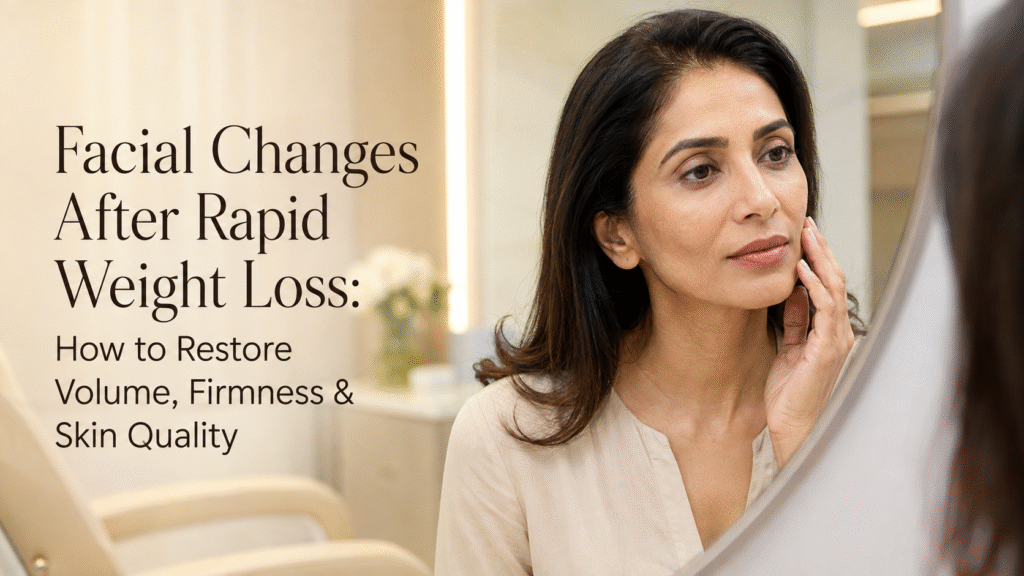
Losing a significant amount of weight can be an important achievement for overall health and confidence. But while the body may become leaner, some people notice an unexpected change in the mirror: the face may begin to look more hollow, tired or less firm than before.
This can happen after significant weight loss achieved through lifestyle changes, medical weight-management programmes or other methods. When facial fat reduces quickly, the skin and supporting tissues may not adapt at the same pace. As a result, areas such as the cheeks, temples, under-eyes and jawline can appear different.
The good news is that facial changes after weight loss are not all the same. Some are related to volume loss, some to skin laxity and others to changes in skin quality. Understanding the difference is important because each concern may require a different approach.
Why Does the Face Change After Significant Weight Loss?
The face contains several layers of tissue, including skin, fat compartments, muscles and deeper structural support. Facial fat is not simply one uniform layer. Different fat compartments contribute to cheek fullness, smooth contours and the transitions between different areas of the face.
When a person loses a substantial amount of weight, some of this facial fat can also decrease. Research into weight-loss-related facial changes has shown that the mid-face can experience measurable volume reduction, particularly in superficial fat compartments.
This can make existing signs of ageing more noticeable or create changes that were less visible before weight loss.
Common changes may include:
- Flatter or less full cheeks
- Hollow-looking temples
- More visible under-eye hollows
- Increased definition of smile lines
- Loose skin around the lower face
- Reduced jawline firmness
- More noticeable fine lines
- A generally tired or deflated appearance
These changes do not happen to everyone, and their severity can vary considerably from person to person.
Is Rapid Weight Loss Ageing Your Face?
Weight loss itself should not automatically be considered harmful to the face. The issue is more complex.
Facial ageing naturally involves gradual changes in skin elasticity, collagen, fat distribution and structural support. Significant weight loss can make some of these changes more visible because there is less soft-tissue volume supporting the skin.
Age also matters. Younger skin often has greater elasticity and may adapt more easily to changes in facial volume. In mature skin, where collagen and elasticity have already reduced naturally, loss of facial volume may make looseness or folds more noticeable.
Other factors such as genetics, sun exposure, smoking, stress, sleep, nutrition and the amount and speed of weight loss can also influence the final appearance.
Volume Loss, Loose Skin or Poor Skin Quality: What’s the Difference?
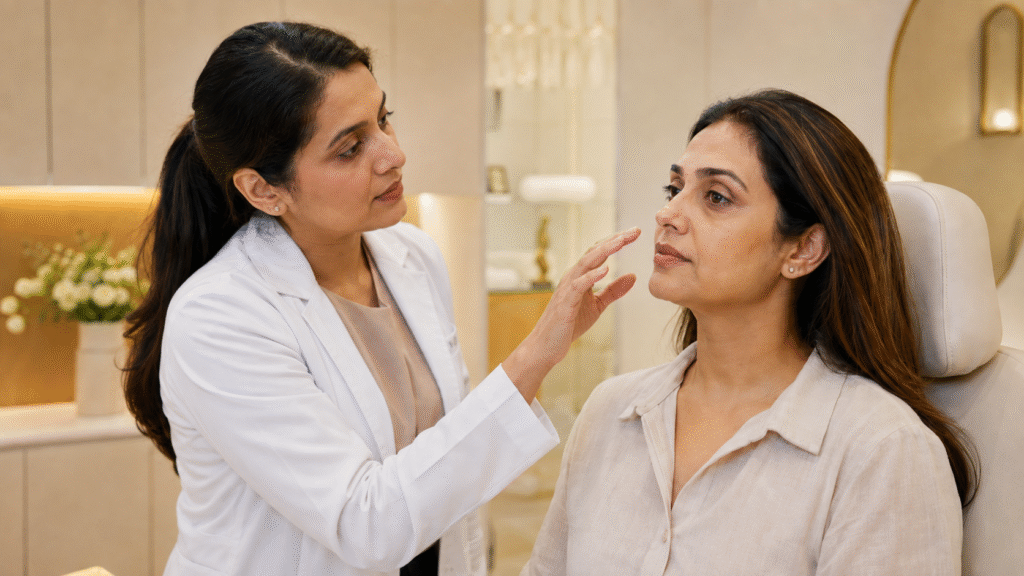
One of the biggest mistakes in facial rejuvenation is assuming that every ageing-looking change needs the same treatment.
After weight loss, three different concerns may be present.
1. Facial Volume Loss
Volume loss occurs when areas that previously had more soft-tissue fullness become flatter or hollow.
Common areas include:
- Cheeks
- Temples
- Under-eye region
- Mid-face
- Areas around the mouth
When volume is the main concern, simply tightening the skin may not recreate the lost facial support.
2. Skin Laxity
Skin laxity refers to looseness or reduced firmness of the skin.
It may appear as:
- Early jowling
- Less defined jawline
- Loose skin under the chin
- Lower-face sagging
- Increased folds
In these cases, the treatment goal may focus more on supporting collagen and improving firmness rather than adding significant volume.
3. Changes in Skin Quality
After significant weight loss, some people also feel that their skin looks thinner, duller, crepey or less resilient.
Skin quality includes characteristics such as:
- Hydration
- Smoothness
- Texture
- Elasticity
- Firmness
- Overall radiance
Improving these concerns requires a different strategy from simply reshaping the face.
How Can Facial Volume Be Restored?
When true facial volume loss is present, carefully planned dermal fillers may be one option.
Dermal fillers can be used to restore selected areas of lost volume and improve facial proportions. However, treatment after significant weight loss should not be about making the face excessively full.
The aim should generally be to restore appropriate support while maintaining the individual’s natural facial features.
Possible areas considered during facial assessment may include the cheeks, temples, chin, jawline or other areas where structural support has decreased.
The amount and placement should always depend on facial anatomy rather than following a standard number of syringes or a social-media trend.
Can Skin Tightening Help After Weight Loss?
When looseness rather than volume loss is the main concern, treatments designed to support collagen remodelling and skin firmness may be considered.
At Aestheticaa by Dr Madhulika, treatment options available for appropriate patients include radiofrequency-based skin tightening and Microneedling RF.
Microneedling RF combines controlled microneedling with radiofrequency energy. It may be used to support improvements in skin firmness, texture and collagen remodelling.
Non-invasive radiofrequency treatments may also be considered when the goal is gradual improvement in skin firmness without adding volume.
However, the degree of laxity is important. Mild or moderate looseness may respond differently from significant excess skin, and no non-surgical procedure should be expected to reproduce the results of surgery in cases of severe skin excess.
What About PDO Threads?
PDO threads may be considered for selected patients where tissue laxity and facial positioning are part of the concern.
They are designed to provide mechanical support while also encouraging collagen response around the treated area.
However, threads are not automatically the best choice after weight loss.
For example, a face with significant volume loss may require a different strategy from a face that has retained volume but developed lower-face laxity.
This is why facial assessment should come before treatment selection.
Why Combination Treatment May Work Better

Facial changes after substantial weight loss often involve more than one layer.
A person may have:
- Cheek volume loss
- Mild jawline laxity
- Reduced skin firmness
- Uneven texture
Using one treatment for all four concerns may not provide the most balanced result.
Instead, a personalised plan may address different problems separately. Depending on individual needs, this could involve carefully selected combinations of volume restoration, collagen-support treatments, skin tightening or texture-focused procedures.
Treatments may also be performed in stages rather than all at once.
This approach allows the face to be evaluated gradually and can help maintain more natural-looking proportions.
When Is the Right Time to Consider Facial Treatment?
Timing is particularly important if your weight is still changing.
If significant additional weight loss is expected, facial volume and skin laxity may continue to change. Performing extensive correction too early can make treatment planning less predictable.
In many cases, it may be useful to evaluate:
- Whether your weight is still changing rapidly
- Whether you are close to your planned weight
- How long your current weight has remained stable
- Which facial changes are actually bothering you
- Whether the concern is volume, laxity, texture or a combination
A medical consultation can help determine whether treatment should begin now or whether waiting for greater weight stability would make more sense.
Don’t Try to Replace Every Bit of Lost Volume
One important principle after weight loss is that facial rejuvenation should not simply aim to recreate the face exactly as it appeared at a higher body weight.
Significant filler volume can sometimes make facial proportions look unnatural.
The goal should instead be balance.
A well-planned approach considers where support has actually been lost and which areas would benefit from subtle correction. Sometimes restoring a small amount of support in the right location can be more effective than adding volume throughout the entire face.
Supporting Your Skin After Weight Loss
Professional treatments are only one part of maintaining skin quality.
Daily habits remain important.
A simple routine may include:
- Consistent broad-spectrum sunscreen
- Appropriate moisturisation
- Adequate dietary protein and balanced nutrition
- Staying adequately hydrated
- Avoiding smoking
- Maintaining a stable, healthy weight where possible
- Using skincare recommended for your individual skin type
Topical skincare cannot replace lost facial fat or significantly lift loose tissue, but it can help support the skin barrier and overall skin condition.
Why Individual Facial Assessment Matters
Two people who lose the same amount of weight may experience completely different facial changes.
One person may mainly lose cheek volume.
Another may develop more visible under-eye hollowing.
Someone else may retain facial volume but notice loose skin around the jawline.
This is why choosing a treatment based only on a photograph, trend or treatment name can be misleading.
At Aestheticaa by Dr Madhulika in Indiranagar, Bengaluru, facial rejuvenation plans are based on individual concerns, facial anatomy, skin quality and the degree of volume loss or laxity present.
The objective is not to change the way you look, but to identify which structural or skin-quality changes are contributing to the concern and select an appropriate approach.

Conclusion
Significant weight loss can change more than body shape. Reduced facial fat may make the cheeks or temples appear hollow, while changes in tissue support can make laxity, folds and fine lines more noticeable.
There is no single treatment for the “post-weight-loss face” because volume loss, loose skin and declining skin quality are different concerns.
Dermal fillers may help restore selected areas of lost volume, while RF-based treatments, Microneedling RF or other collagen-support approaches may be considered for skin firmness and quality. PDO threads may also have a role in carefully selected cases.
The most important step is identifying what has actually changed before deciding how to treat it. A personalised, gradual approach can help preserve natural facial proportions while addressing the specific concerns that appear after significant weight loss.