
Does Creatine Cause Hair Loss? Gym Skin & Hair Myths
Creatine is one of the most widely used fitness supplements among people who regularly exercise, lift weights or participate in strength training. It is commonly taken to support muscle strength, exercise performance and recovery between repeated high-intensity efforts.
However, alongside its popularity, creatine has become the subject of several concerns, particularly regarding hair loss.
Many gym-goers worry that taking creatine may increase testosterone, raise DHT levels or accelerate male pattern baldness. Others notice increased hair shedding after starting a new workout routine and immediately assume that their supplements are responsible.
Similar myths surround protein powders, sweating, frequent shampooing and gym-related acne.
But does creatine actually cause hair loss, or is this another fitness myth?
Current scientific evidence does not demonstrate that creatine supplementation causes hair loss. Understanding the research, along with other factors that influence skin and hair health, can help separate genuine concerns from unsupported claims.
What Is Creatine and Why Do Gym-Goers Use It?
Creatine is a naturally occurring compound produced by the body from amino acids. It is also present in foods such as meat and fish.
Most of the body’s creatine is stored in skeletal muscles, where it helps replenish adenosine triphosphate (ATP), the energy source used during short bursts of intense physical activity.
Creatine monohydrate is one of the most extensively studied forms of creatine supplementation.
People commonly use it to support:
- Strength training performance
- Short-duration, high-intensity exercise
- Muscle strength development
- Repeated exercise efforts
- Gains in lean muscle mass when combined with resistance training
Creatine is not an anabolic steroid, and it does not work by directly supplying testosterone.
Despite its well-established role in sports nutrition, questions about its effect on hormones and hair follicles have continued for years.
Does Creatine Cause Hair Loss?
There is currently no convincing clinical evidence that creatine supplementation directly causes hair loss.
The concern originated primarily from a small study published in 2009 that observed increased levels of dihydrotestosterone, commonly called DHT, in male rugby players taking creatine.
DHT is a hormone associated with androgenetic alopecia, also known as male or female pattern hair loss.
Because DHT contributes to hair follicle miniaturisation in genetically susceptible individuals, researchers and supplement users questioned whether creatine might increase the risk of baldness.
However, an increase in a hormone level does not automatically establish that a supplement causes hair loss.
Importantly, the original study did not measure hair shedding, hair density or actual hair loss.
Later scientific research has provided more information about this relationship.
Why Did People Start Linking Creatine to Baldness?
Much of the creatine and hair loss discussion can be traced to a 2009 study involving college-aged male rugby players.
The participants received creatine supplementation over three weeks, including an initial loading phase followed by a maintenance phase.
Researchers observed that DHT levels increased during the supplementation period.
The findings attracted attention because DHT is involved in the development of hereditary pattern hair loss.
However, several limitations are important:
- The study involved a small number of participants.
- The supplementation period lasted only three weeks.
- Researchers measured hormone levels rather than actual hair loss.
- The findings did not establish whether creatine affected hair follicles.
- The observed DHT values remained within normal physiological ranges.
The study raised a question worth investigating, but it did not prove that creatine causes baldness.
Over time, the distinction between a possible hormonal effect and demonstrated hair loss was often lost in online discussions.
What Does the Latest Research Say About Creatine and Hair Loss?
A randomised controlled trial published in April 2025 directly investigated whether creatine supplementation affected hormones and hair follicle health.
The study recruited 45 resistance-trained men aged between 18 and 40 years.
Participants were assigned to receive either:
- Creatine monohydrate at 5 grams per day
- A placebo supplement
The study lasted 12 weeks, and 38 participants completed it.
Researchers measured hormone levels, including testosterone and DHT, as well as several hair-related measurements.
These included hair density, follicular unit count and hair thickness.
What Did Researchers Find?
The study found no statistically significant differences between the creatine and placebo groups in:
- DHT levels
- DHT-to-testosterone ratio
- Hair density
- Hair follicle measurements
- Hair thickness
- Other measured hair-growth parameters
The findings did not support the claim that creatine causes hair loss during the 12-week study period.
This research is particularly important because it examined actual hair characteristics rather than relying only on hormone measurements.
However, the study was relatively small, included only men and lasted three months.
Longer-term research involving more diverse participants would help clarify whether these findings remain consistent across different populations and supplement-use patterns.
The available evidence is reassuring, but it should not be interpreted as proof that every possible long-term effect has been ruled out.
Research reference: Does Creatine Cause Hair Loss? A 12-Week Randomized Controlled Trial (2025)
What Is DHT and How Does It Affect Hair Growth?
Dihydrotestosterone, or DHT, is an androgen hormone formed when the body converts testosterone through an enzyme called 5-alpha-reductase.
DHT plays several normal biological roles, but it is also involved in androgenetic alopecia.
In people who are genetically susceptible to pattern hair loss, DHT can contribute to the gradual miniaturisation of certain hair follicles.
As these follicles become smaller, they produce progressively finer and shorter hairs.
Over time, this process may result in visible thinning.
Common signs include:
- A gradually receding hairline
- Thinning around the crown
- Reduced density along the central scalp
- Increasing scalp visibility
- Progressive changes in hair thickness
However, DHT levels alone do not determine whether someone develops pattern hair loss.
Genetics and follicular sensitivity are especially important.
Two individuals with similar circulating DHT levels may experience very different patterns of hair growth.
This is why the presence of DHT in the body should not automatically be interpreted as evidence of a hair-loss problem.
Can Creatine Make Genetic Hair Loss Worse?
This is an important distinction.
People with a family history of male or female pattern hair loss may already be genetically predisposed to gradual thinning.
In these individuals, follicular sensitivity to androgens can contribute to hair miniaturisation over time.
However, current research has not demonstrated that creatine supplementation accelerates this process.
The 2025 controlled trial did not identify significant differences in DHT or hair measurements between the groups.
Nevertheless, longer-term studies involving individuals with established androgenetic alopecia would provide additional evidence.
If someone notices progressive thinning while taking creatine, it is important to assess the actual pattern and cause rather than assuming the supplement is responsible.
Why Do Some People Experience Hair Fall After Starting the Gym?
Hair loss that begins around the same time as a new fitness routine may have several possible explanations.
Starting regular exercise does not automatically cause hair loss.
However, changes in nutrition, body weight, physical stress and existing medical conditions can affect the normal hair-growth cycle.
1. Rapid Weight Loss and Crash Dieting
Some people begin gym training with strict calorie restrictions to reduce body fat quickly.
When calorie intake becomes too low, the body may not receive adequate energy and nutrients to support normal hair growth.
A major physical or nutritional change can trigger a condition called telogen effluvium.
In telogen effluvium, more hair follicles than usual enter the resting phase, leading to increased shedding several weeks or months later.
This type of shedding often affects the entire scalp rather than creating a single bald patch.
For more information, read Aestheticaa’s related article:
Hair Loss After Rapid Weight Loss & GLP-1 Medications: Causes, Recovery and Treatment Options
2. Inadequate Protein and Nutrient Intake
Hair is primarily made of keratin, a structural protein.
Although protein supplements are popular among gym-goers, overall dietary balance remains important.
Someone may consume sufficient protein powder but still follow a diet that lacks essential nutrients.
Nutritional factors associated with hair shedding may include:
- Inadequate protein intake
- Low iron stores
- Zinc deficiency
- Very low calorie intake
- Certain vitamin deficiencies
Not every case of hair loss is caused by a deficiency.
Blood tests and nutritional supplementation should be based on individual symptoms, medical history and professional assessment.
Taking excessive vitamins or minerals unnecessarily can sometimes worsen hair problems.
3. Physical Stress and Inadequate Recovery
Exercise is beneficial for overall health.
However, an abrupt increase in training intensity combined with inadequate sleep, severe calorie restriction or insufficient recovery may create additional physiological stress.
Major physical stressors can contribute to temporary hair shedding in susceptible individuals.
This does not mean that ordinary strength training damages hair follicles.
A balanced exercise programme, appropriate recovery and adequate nutrition are generally better approaches than extreme training and restrictive dieting.
4. Existing Genetic Hair Thinning
Sometimes, hair thinning becomes noticeable after someone begins going to the gym, even though the underlying condition started earlier.
Male and female pattern hair loss usually develops gradually.
Changes in hairstyles, lighting, body weight or attention to appearance may make previously unnoticed thinning more apparent.
A proper scalp examination can help determine whether the concern is temporary shedding or progressive pattern hair loss.
Does Sweating During Workouts Cause Hair Loss?
Sweating is a normal physiological response that helps regulate body temperature.
Sweat itself does not directly cause permanent hair loss.
However, leaving sweat, excess oil and product buildup on the scalp for prolonged periods may contribute to irritation or worsen certain existing scalp conditions.
People who exercise frequently may sometimes notice:
- Scalp itching
- Increased oiliness
- Flaking or dandruff
- Unpleasant scalp odour
- Irritation around the hairline
- Follicular inflammation
These conditions do not automatically lead to permanent baldness, but persistent inflammation or infection may require medical attention.
Keeping the scalp clean and choosing a suitable hair-washing routine can help maintain scalp comfort.
Does Washing Hair Every Day After the Gym Cause Hair Fall?
Frequent shampooing is another common concern among people who exercise regularly.
Some believe that washing hair every day weakens the roots or increases hair loss.
However, shampooing does not normally cause hair follicles to stop producing hair.
People often notice strands falling during washing because hairs that have already entered the shedding phase are released while shampooing or rinsing.
The appropriate washing frequency depends on:
- Scalp oiliness
- Hair texture
- Sweat production
- Dandruff or other scalp conditions
- Product buildup
- Individual sensitivity
Someone with a very oily scalp who exercises daily may need to wash more frequently than someone with dry or curly hair.
Using a gentle shampoo and avoiding aggressive rubbing can help reduce irritation and breakage.
Very hot water, harsh shampoos and rough towel-drying may damage the hair shaft, even though they are not equivalent to permanent follicular hair loss.
Does Whey Protein Cause Acne or Hair Loss?
Whey protein is commonly used to help people meet their daily protein requirements.
It is derived from milk and contains amino acids that support protein synthesis.
Although whey protein is generally well tolerated, researchers have investigated whether it may contribute to acne in some individuals.
Whey Protein and Acne
Some observational studies and case reports have found an association between whey protein supplementation and acne.
One proposed explanation involves metabolic signalling pathways associated with insulin and insulin-like growth factor-1 (IGF-1), which can influence sebaceous gland activity.
However, research findings are not completely consistent.
A randomised controlled study published in 2024 did not find significantly greater acne worsening among participants taking whey protein compared with a non-whey supplement.
Therefore, it would be inaccurate to say that whey protein causes acne in everyone.
Individual susceptibility, hormonal factors, existing acne, dietary patterns and skincare habits may also contribute.
If breakouts begin after introducing a supplement, reviewing the full routine with a medical professional can help identify possible triggers.
Does Whey Protein Cause Hair Loss?
There is insufficient convincing clinical evidence that ordinary whey protein supplementation directly causes hair loss.
Adequate dietary protein is important for normal hair health.
However, protein supplements cannot replace balanced nutrition, and taking additional protein does not necessarily prevent genetic hair thinning or other medical causes of hair loss.
It is important to distinguish ordinary protein supplements from hormonal performance-enhancing substances.
Can Anabolic Steroids Cause Hair Loss and Acne?
Unlike creatine, anabolic-androgenic steroids can significantly affect hormonal activity.
These substances are sometimes misused to accelerate muscle growth or improve physical performance.
Anabolic steroid exposure is associated with several skin and hair concerns, including:
- Increased sebum production
- Facial and body acne
- Severe inflammatory acne
- Scalp oiliness
- Worsening of androgen-sensitive hair thinning
- Other hormonal and systemic side effects
In genetically susceptible individuals, anabolic steroids may accelerate pattern hair loss.
This is an important reason why creatine and anabolic steroids should never be treated as equivalent substances.
Creatine is a nutritional performance supplement, whereas anabolic-androgenic steroids directly influence androgen signalling and carry substantially different risks.
Can Going to the Gym Cause Acne?
Exercise itself is not inherently harmful to the skin.
However, certain workout-related habits may contribute to acne flare-ups.
During exercise, sweat can mix with oil, dirt, cosmetic products and microorganisms on the skin.
Tight clothing, repeated friction and shared equipment may further aggravate acne-prone areas.
Gym-related breakouts are commonly noticed on the:
- Forehead
- Cheeks
- Chest
- Shoulders
- Upper back
The problem is often associated with the combination of sweat, friction and skin congestion rather than exercise alone.
Sweat and Occlusive Clothing
Tight synthetic workout clothing can trap heat and moisture against the skin.
Repeated friction from sportswear, straps or protective equipment may worsen certain types of acne.
Wearing clean, breathable clothing and changing after exercise may help reduce irritation.
Touching the Face During Workouts
Gym equipment and shared surfaces may accumulate sweat, oils and microorganisms.
Frequently touching the face or rubbing the forehead with unwashed hands can transfer these substances to the skin.
Using a clean towel and gently patting away sweat is preferable to aggressive rubbing.
Exercising With Heavy Makeup
Heavy makeup may contribute to pore congestion when combined with sweat and oil.
Removing makeup before exercise and choosing non-comedogenic skincare products may help reduce breakouts.
For people with persistent acne, professional assessment can help determine whether acne-focused skincare or treatments are suitable.
Related service: Acne Peel Treatment at Aestheticaa
Common Gym Skin and Hair Myths You Should Stop Believing
Fitness-related skin and hair advice spreads quickly through social media. However, not every popular claim is supported by scientific evidence.
Myth 1: Creatine Always Causes Baldness
Current clinical evidence does not demonstrate that creatine causes hair loss.
A 2025 controlled trial found no significant difference in hair-related measurements between participants taking creatine and those taking a placebo.
Myth 2: Weightlifting Automatically Increases Hair Loss
Ordinary resistance training has not been established as a direct cause of baldness.
Genetics, hormonal sensitivity, nutritional factors and underlying medical conditions are more important considerations.
Myth 3: Sweat Damages Hair Roots
Sweat is a normal part of the body’s temperature-regulation process.
It does not directly destroy hair follicles, although persistent scalp irritation or infection should be evaluated.
Myth 4: Every Protein Supplement Causes Acne
Some research has associated whey supplementation with acne, but evidence is mixed.
Not every person who consumes whey protein develops breakouts.
Myth 5: Shampooing After Every Workout Causes Baldness
Appropriate scalp cleansing does not normally cause permanent hair loss.
However, harsh products and rough handling may increase hair breakage.
Myth 6: More Hair Vitamins Mean Faster Hair Growth
Taking additional vitamins without a diagnosed deficiency does not guarantee better hair growth.
Excessive intake of certain nutrients, including vitamin A and selenium, may actually contribute to hair loss.
How to Protect Your Skin and Hair While Going to the Gym
Maintaining a regular fitness routine does not have to come at the expense of skin or hair health.
Simple daily habits can help reduce preventable problems.
Maintain Balanced Nutrition
Ensure your diet provides adequate calories, protein, healthy fats, vitamins and minerals.
Avoid extreme calorie restrictions, especially when combining intensive workouts with weight-loss goals.
Keep Your Scalp Clean
Wash your scalp according to its oiliness, sweat levels and individual needs.
Use suitable shampoos and avoid harsh scrubbing.
If dandruff, itching or inflammation persists, seek appropriate medical advice.
Follow a Simple Post-Workout Skincare Routine
After exercising:
- Gently cleanse the face.
- Shower and change out of sweaty clothing.
- Use a lightweight, non-comedogenic moisturiser.
- Apply sunscreen when exposed to daylight.
- Avoid aggressive scrubbing or unnecessary exfoliation.
People with acne-prone skin may benefit from suitable ingredients such as salicylic acid, although the product choice should reflect their skin sensitivity.
Prioritise Sleep and Recovery
Adequate sleep and recovery support general health and help the body adapt to exercise.
Avoiding extreme overtraining and maintaining consistent nutrition may also reduce physiological stress.
Avoid Unsupervised Hormonal Supplements
Be cautious with bodybuilding products that contain anabolic agents, undeclared ingredients or hormone-altering substances.
These products can carry risks beyond skin and hair concerns.
What Should You Do if Hair Fall Starts After Taking Creatine?
If you notice increased hair shedding after starting creatine, do not immediately assume that creatine is the cause.
Instead, consider whether other changes have occurred around the same time.
These may include:
- Starting an aggressive calorie-deficit diet
- Losing weight rapidly
- Changing protein or supplement intake
- Experiencing illness or significant stress
- Increasing workout intensity substantially
- Developing new scalp symptoms
- Noticing an existing family pattern of baldness
A healthcare professional can assess your medical history, diet, medications, supplements and hair-loss pattern.
Depending on the findings, scalp examination or selected blood tests may be appropriate.
There is no general recommendation to stop creatine solely to prevent hair loss based on the current evidence. However, decisions about supplement use should consider individual health circumstances, particularly if a medical condition or medication interaction is involved.
When Should Gym-Related Hair Fall Be Evaluated?
Occasional hair shedding is part of the normal hair-growth cycle.
However, certain changes deserve professional attention.
Consider a hair and scalp assessment if you notice:
- Persistent or increasing hair shedding
- A gradually receding hairline
- Noticeable thinning around the crown
- Widening of the central hair part
- Sudden bald patches
- Persistent scalp itching or inflammation
- Hair loss following rapid weight reduction
- Continued thinning despite adequate nutrition
The pattern of hair loss is often more informative than the timing of supplement use alone.
Early evaluation can help distinguish temporary shedding from progressive hair-loss conditions.
Hair Fall Treatment Options at Aestheticaa by Dr. Madhulika
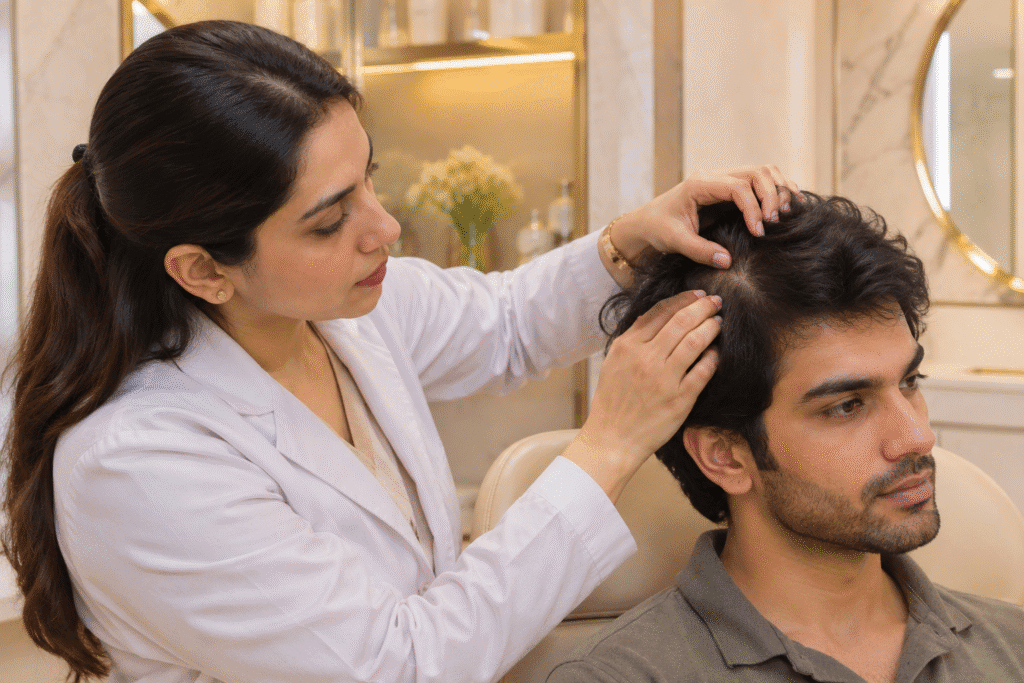
Hair thinning can have several underlying causes, including genetic predisposition, nutritional deficiencies, hormonal factors and changes in the normal hair-growth cycle.
At Aestheticaa by Dr. Madhulika, located in Indiranagar, Bengaluru, hair concerns can be assessed individually before considering treatment options.
The clinic offers professional hair-care services including GFC, PRP and hair mesotherapy.
GFC and PRP for Hair
Growth Factor Concentrate (GFC) and Platelet-Rich Plasma (PRP) are procedures that use components derived from the patient’s own blood.
These procedures are sometimes considered as part of a management plan for selected types of hair thinning.
However, their suitability depends on the diagnosis, and results vary between individuals.
They are not substitutes for identifying nutritional deficiencies, treating scalp disease or managing other underlying conditions.
Related service: GFC PRP for Hair
Hair Mesotherapy
Hair mesotherapy involves delivering selected substances into the scalp.
It may be discussed for certain hair concerns, but the evidence supporting its effectiveness varies according to the formulation and condition being treated.
It should not be regarded as a universally effective treatment for every type of hair loss.
Related service: Mesotherapy for Hair
Personalised Hair and Scalp Assessment
The most appropriate management depends on whether the concern involves:
- Temporary hair shedding
- Male or female pattern hair loss
- Nutritional deficiencies
- Scalp inflammation
- Hair breakage
- Other medical causes
Dr. Madhulika Mohanty emphasises individual assessment and realistic treatment expectations rather than assuming that every case of hair fall has the same cause.
For those experiencing persistent hair thinning or looking for professional hair fall treatment in Indiranagar, Bangalore, a consultation can help identify suitable next steps.
Conclusion
The belief that creatine causes hair loss has circulated for years, largely because of an early study examining changes in DHT levels.
However, the available scientific evidence does not establish that creatine supplementation causes baldness.
A controlled trial published in 2025 found no significant differences in DHT levels or measured hair-health outcomes between participants using creatine and those receiving a placebo over 12 weeks. Although longer-term research would be valuable, these findings do not support the common claim that creatine directly causes hair loss.
Hair shedding among gym-goers may instead involve factors such as genetics, rapid weight loss, inadequate nutrition, physical stress or underlying medical conditions.
Similarly, fitness-related skin problems are not always caused by exercise itself. Sweat, friction, skincare habits and certain substances may contribute to acne or scalp irritation in susceptible individuals.
Maintaining balanced nutrition, appropriate skin and scalp hygiene, adequate recovery and realistic expectations can support healthier skin and hair while pursuing fitness goals.
If hair shedding becomes persistent or progressive, identifying the underlying cause is more useful than automatically blaming a supplement.
At Aestheticaa by Dr. Madhulika in Indiranagar, Bengaluru, individual skin and hair assessments can help guide suitable care based on the type and severity of the concern.